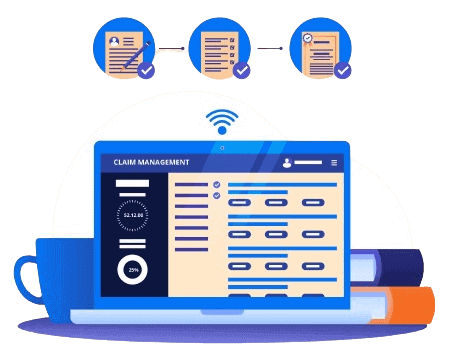










Medical claims management means organization, billing, filing, updating and processing of medical claims related to patient diagnoses, treatments and medications. Without effective claims management in healthcare, patients wouldn't know what they owe and clinical offices wouldn't get the assets due for patient administrations.
Claims management consists of maintaining and updating patient medical histories, making changes in medical codes, as well as reporting exams and laboratory results. Claim records are also responsible for collecting, reporting and storing patient information. Medical claims management is necessary to keep track of all medical visits, treatments and expenses of multiple medical facilities and complex health insurance coverage policies.

Vast Edge's Online Mediclaim solution offers:
Trusted by Global Brands
Unlocking the Advantages of Healthcare Claims Management
To take one step towards building a better medical claim processing system, Vast Edge has come up with the idea of process driven automation to analyse and integrate CCLF (Claims and Claims Line Feed) data. By incorporating claims management software with customized edits into the workflow system, providers can thoroughly review every line of every encounter and ensure that each claim is coded correctly and contains the correct information before the claim is invoiced and submitted for reimbursement.

How Vast Edge can help?
Prioritize
Monitor
Analyze
Software Solution for Transparent Medical Claims by Vast Edge-The Benefits
- 1Implementing 4 layers of security for HIPAA compliance:
With Vast Edge, you can achieve auditable HIPAA compliance, and our data center and hosting solutions give you the peace of mind you need to comply with HIPAA regulations. We, at Vast Edge, offer 4 layers of security in HIPAA compliance to guarantee that your data is protected.
- 2Checking healthcare plan expiration dates & matching against current beneficiary BAR report:
We are dedicatedly saving you enough by regularly checking on plan expiration dates and matching the beneficiary BAR report in healthcare plan.
- 3Closely tracking hospice code 50 claims and average hospice days:
We closely take care of hospice code 50, i.e., tracking the patients who are discharged/transferred to hospice, also tracking average tracking days.
- 4Tracking annual exams in the last 365 days & sending proactive notifications
We use proactive outbound notifications that will help prevent problems or make the patient's situation more manageable.
- 5Checking for Duplicate Claims:
We use a unit of service multiplier rather than billing services on individual lines to show the appropriate unit/dosage.
- 6Checking Xref MBI's:
We regularly check MBI with MBI look-up tools in cross-reference database too.
- 7Generating 835 and NACHA on the day of receiving Claim reduction file:
We generate 835 and NACHA Health Care Claim Payment/Advice provides detailed payment information about health care claims.
- 8Performing 3 yr CCLF historical claim analysis:
We perform CCLF historical claim analysis to assist active Shared Savings Program ACOs with coordination of care.
- 9Integrating 835 with EMR systems:
EMR system's ALLSCRIPTS and EPIC were used to keep digital version of the paper charts in the clinician's office in integration with Health Care Claim Payment/Advice (835).
- 10Reconciling Weekly Claim Reduction Data with Month end CCLF Part A/B claims:
We are trying to balance Weekly Claim Reduction Data with CCLF Part A/B claims at the end of the month.
FAQs
Frequently Asked Questions
Q1. What is healthcare claims management software?
Healthcare claims management software is a tool used by healthcare providers, Accountable Care Organizations (ACOs), and payers to streamline the process of submitting, processing, and managing insurance claims electronically.
Q2. What are the benefits of using healthcare claims management software?
Some benefits of using healthcare claims management software include increased efficiency in claim processing, reduced errors, faster payments, improved revenue cycle management, and better compliance with regulations.
Q3. How can ACOs and healthcare providers benefit from EHR integration in claims management software?
Integrating Electronic Health Records (EHR) with claims management software allows ACOs and providers to access patient information in real-time, submit claims more accurately, improve clinical documentation, and streamline workflows.
Q4. How does the software help in tracking claims status and denials?
Our software provides real-time tracking of claims status and denials, allowing healthcare organizations to identify and resolve issues quickly, track payment discrepancies, reduce denials, and improve revenue cycle management.