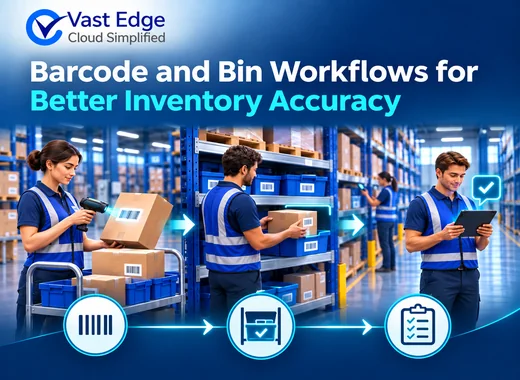
Barcode and bin workflows improve inventory accuracy when every physical move requires a scan of the item, quantity and location, followed by an immediate system confirmation. The control works only if labels are unique, units of measure are governed, exceptions are visible and cycle counts test the record against the floor.
How Do Barcode and Bin Workflows Improve Inventory Accuracy?
Published • 10 Nov 2026
C
AuthorChloe Gallagher
What must be defined before labels are printed?
What must be defined before labels are printed? Start with item identifiers, barcode symbologies, units of measure, lot or serial rules, and a unique location hierarchy. Write each requirement as an observable event with an owner, timestamp and expected result. A broad feature label does not explain which record is authoritative, what the operator sees or how the team proves that the event completed.
Build the procedure around item identifiers, barcode symbologies, units of measure, lot or serial rules, and a unique location hierarchy. Separate the normal path from exceptions and require a reason code when a user bypasses an expected control. The record should show who acted, what changed, which source was used and whether another system or business owner must approve the result.
Test item identifiers, barcode symbologies, units of measure, lot or serial rules, and a unique location hierarchy with representative data and least-privilege roles. Include a partial transaction, an invalid value, a duplicate attempt and a delayed dependency. Compare the final business record with the operational evidence, then record gaps as configuration, data, process, integration or product issues.
How should receiving scans create reliable inventory?
How should receiving scans create reliable inventory? Start with expected receipts, overages, shortages, damage, quarantine, label quality, and receipt ownership. Write each requirement as an observable event with an owner, timestamp and expected result. A broad feature label does not explain which record is authoritative, what the operator sees or how the team proves that the event completed.
Build the procedure around expected receipts, overages, shortages, damage, quarantine, label quality, and receipt ownership. Separate the normal path from exceptions and require a reason code when a user bypasses an expected control. The record should show who acted, what changed, which source was used and whether another system or business owner must approve the result.
Test expected receipts, overages, shortages, damage, quarantine, label quality, and receipt ownership with representative data and least-privilege roles. Include a partial transaction, an invalid value, a duplicate attempt and a delayed dependency. Compare the final business record with the operational evidence, then record gaps as configuration, data, process, integration or product issues.
How should put-away and replenishment control bins?
How should put-away and replenishment control bins? Start with source and destination scans, capacity rules, mixed stock, replenishment triggers, and confirmation timing. Write each requirement as an observable event with an owner, timestamp and expected result. A broad feature label does not explain which record is authoritative, what the operator sees or how the team proves that the event completed.
Build the procedure around source and destination scans, capacity rules, mixed stock, replenishment triggers, and confirmation timing. Separate the normal path from exceptions and require a reason code when a user bypasses an expected control. The record should show who acted, what changed, which source was used and whether another system or business owner must approve the result.
Test source and destination scans, capacity rules, mixed stock, replenishment triggers, and confirmation timing with representative data and least-privilege roles. Include a partial transaction, an invalid value, a duplicate attempt and a delayed dependency. Compare the final business record with the operational evidence, then record gaps as configuration, data, process, integration or product issues.
How do picking and packing scans prevent errors?
How do picking and packing scans prevent errors? Start with order identity, item and bin validation, quantity capture, short picks, substitutions, packing verification, and shipment status. Write each requirement as an observable event with an owner, timestamp and expected result. A broad feature label does not explain which record is authoritative, what the operator sees or how the team proves that the event completed.
Build the procedure around order identity, item and bin validation, quantity capture, short picks, substitutions, packing verification, and shipment status. Separate the normal path from exceptions and require a reason code when a user bypasses an expected control. The record should show who acted, what changed, which source was used and whether another system or business owner must approve the result.
Test order identity, item and bin validation, quantity capture, short picks, substitutions, packing verification, and shipment status with representative data and least-privilege roles. Include a partial transaction, an invalid value, a duplicate attempt and a delayed dependency. Compare the final business record with the operational evidence, then record gaps as configuration, data, process, integration or product issues.
How should cycle counts investigate differences?
How should cycle counts investigate differences? Start with blind counts, recount thresholds, reason codes, approvals, adjustment posting, and recurring root causes. Write each requirement as an observable event with an owner, timestamp and expected result. A broad feature label does not explain which record is authoritative, what the operator sees or how the team proves that the event completed.
Build the procedure around blind counts, recount thresholds, reason codes, approvals, adjustment posting, and recurring root causes. Separate the normal path from exceptions and require a reason code when a user bypasses an expected control. The record should show who acted, what changed, which source was used and whether another system or business owner must approve the result.
Test blind counts, recount thresholds, reason codes, approvals, adjustment posting, and recurring root causes with representative data and least-privilege roles. Include a partial transaction, an invalid value, a duplicate attempt and a delayed dependency. Compare the final business record with the operational evidence, then record gaps as configuration, data, process, integration or product issues.
For related planning, review the open-source WMS guide and the integrated operations case study. Use these resources for context, not as proof of a capability in this article.
Which exceptions need a visible queue?
Which exceptions need a visible queue? Start with unreadable labels, unknown items, occupied bins, duplicate scans, offline devices, interface failures, and supervisor decisions. Write each requirement as an observable event with an owner, timestamp and expected result. A broad feature label does not explain which record is authoritative, what the operator sees or how the team proves that the event completed.
Build the procedure around unreadable labels, unknown items, occupied bins, duplicate scans, offline devices, interface failures, and supervisor decisions. Separate the normal path from exceptions and require a reason code when a user bypasses an expected control. The record should show who acted, what changed, which source was used and whether another system or business owner must approve the result.
Test unreadable labels, unknown items, occupied bins, duplicate scans, offline devices, interface failures, and supervisor decisions with representative data and least-privilege roles. Include a partial transaction, an invalid value, a duplicate attempt and a delayed dependency. Compare the final business record with the operational evidence, then record gaps as configuration, data, process, integration or product issues.
What should teams test before go-live?
What should teams test before go-live? Start with representative products, real devices, partial transactions, duplicate protection, permission tests, reconciliation, and support evidence. Write each requirement as an observable event with an owner, timestamp and expected result. A broad feature label does not explain which record is authoritative, what the operator sees or how the team proves that the event completed.
Build the procedure around representative products, real devices, partial transactions, duplicate protection, permission tests, reconciliation, and support evidence. Separate the normal path from exceptions and require a reason code when a user bypasses an expected control. The record should show who acted, what changed, which source was used and whether another system or business owner must approve the result.
Test representative products, real devices, partial transactions, duplicate protection, permission tests, reconciliation, and support evidence with representative data and least-privilege roles. Include a partial transaction, an invalid value, a duplicate attempt and a delayed dependency. Compare the final business record with the operational evidence, then record gaps as configuration, data, process, integration or product issues.
Key Takeaways
- 01Define data ownership and the smallest safe scope before execution.
- 02Test normal work, partial work, invalid data, duplicate attempts and delayed dependencies.
- 03Require visible exception ownership, evidence and business validation.
- 04Treat current documentation and observed tests as evidence; do not turn assumptions into product claims.
Explore the Relevant Vast Edge Solution
If your organization needs help applying these controls, review Vast Edge WMS. Use a discovery session to confirm supported scope, exclusions, administration and acceptance evidence before discussing implementation.
Loading...