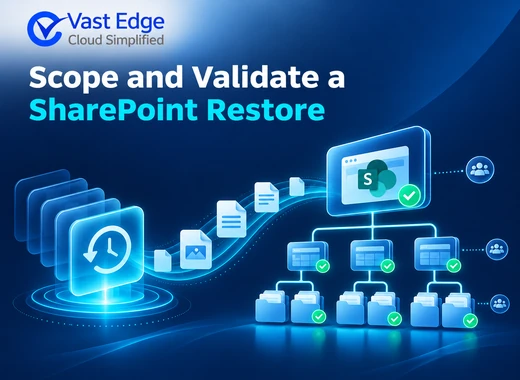
A safe SharePoint restore starts by identifying the affected site, files, folders, versions, time window and business dependencies. Choose the smallest supported restore scope and destination, record the administrator and approval, then validate content, metadata, inherited permissions, links and workflows. A completed job is not proof that users can work normally.
How Should You Scope and Validate a SharePoint Restore?
Published • 10 Nov 2026
C
AuthorChloe Gallagher
What evidence should be captured before restoration?
What evidence should be captured before restoration? Start with incident time, site and library URLs, item paths, owners, deletion or corruption type, audit evidence, and containment. Write each requirement as an observable event with an owner, timestamp and expected result. A broad feature label does not explain which record is authoritative, what the operator sees or how the team proves that the event completed.
Build the procedure around incident time, site and library URLs, item paths, owners, deletion or corruption type, audit evidence, and containment. Separate the normal path from exceptions and require a reason code when a user bypasses an expected control. The record should show who acted, what changed, which source was used and whether another system or business owner must approve the result.
Test incident time, site and library URLs, item paths, owners, deletion or corruption type, audit evidence, and containment with representative data and least-privilege roles. Include a partial transaction, an invalid value, a duplicate attempt and a delayed dependency. Compare the final business record with the operational evidence, then record gaps as configuration, data, process, integration or product issues.
How do native recovery and backup differ?
How do native recovery and backup differ? Start with recycle bins, version history, retention, paid Microsoft 365 Backup, third-party policies, recovery points, and current documentation. Write each requirement as an observable event with an owner, timestamp and expected result. A broad feature label does not explain which record is authoritative, what the operator sees or how the team proves that the event completed.
Build the procedure around recycle bins, version history, retention, paid Microsoft 365 Backup, third-party policies, recovery points, and current documentation. Separate the normal path from exceptions and require a reason code when a user bypasses an expected control. The record should show who acted, what changed, which source was used and whether another system or business owner must approve the result.
Test recycle bins, version history, retention, paid Microsoft 365 Backup, third-party policies, recovery points, and current documentation with representative data and least-privilege roles. Include a partial transaction, an invalid value, a duplicate attempt and a delayed dependency. Compare the final business record with the operational evidence, then record gaps as configuration, data, process, integration or product issues.
How should you choose scope and destination?
How should you choose scope and destination? Start with selected files or folders, original location or new recovery folder, overwrite risk, naming, approvals, and controlled sampling. Write each requirement as an observable event with an owner, timestamp and expected result. A broad feature label does not explain which record is authoritative, what the operator sees or how the team proves that the event completed.
Build the procedure around selected files or folders, original location or new recovery folder, overwrite risk, naming, approvals, and controlled sampling. Separate the normal path from exceptions and require a reason code when a user bypasses an expected control. The record should show who acted, what changed, which source was used and whether another system or business owner must approve the result.
Test selected files or folders, original location or new recovery folder, overwrite risk, naming, approvals, and controlled sampling with representative data and least-privilege roles. Include a partial transaction, an invalid value, a duplicate attempt and a delayed dependency. Compare the final business record with the operational evidence, then record gaps as configuration, data, process, integration or product issues.
What happens to permissions during granular restore?
What happens to permissions during granular restore? Start with Microsoft documented inheritance at the destination, non-restoration of item-level permissions, group access, sharing, and least privilege. Write each requirement as an observable event with an owner, timestamp and expected result. A broad feature label does not explain which record is authoritative, what the operator sees or how the team proves that the event completed.
Build the procedure around Microsoft documented inheritance at the destination, non-restoration of item-level permissions, group access, sharing, and least privilege. Separate the normal path from exceptions and require a reason code when a user bypasses an expected control. The record should show who acted, what changed, which source was used and whether another system or business owner must approve the result.
Test Microsoft documented inheritance at the destination, non-restoration of item-level permissions, group access, sharing, and least privilege with representative data and least-privilege roles. Include a partial transaction, an invalid value, a duplicate attempt and a delayed dependency. Compare the final business record with the operational evidence, then record gaps as configuration, data, process, integration or product issues.
How should restored content be validated?
How should restored content be validated? Start with file opening, versions, metadata, folder structure, counts, owners, members, guests, links, and business sign-off. Write each requirement as an observable event with an owner, timestamp and expected result. A broad feature label does not explain which record is authoritative, what the operator sees or how the team proves that the event completed.
Build the procedure around file opening, versions, metadata, folder structure, counts, owners, members, guests, links, and business sign-off. Separate the normal path from exceptions and require a reason code when a user bypasses an expected control. The record should show who acted, what changed, which source was used and whether another system or business owner must approve the result.
Test file opening, versions, metadata, folder structure, counts, owners, members, guests, links, and business sign-off with representative data and least-privilege roles. Include a partial transaction, an invalid value, a duplicate attempt and a delayed dependency. Compare the final business record with the operational evidence, then record gaps as configuration, data, process, integration or product issues.
For related planning, review the Office 365 backup evaluation guide and the backup and disaster recovery planning. Use these resources for context, not as proof of a capability in this article.
Which dependencies need separate testing?
Which dependencies need separate testing? Start with Power Automate flows, lists, pages, search, Teams-connected files, apps, shortcuts, and downstream references. Write each requirement as an observable event with an owner, timestamp and expected result. A broad feature label does not explain which record is authoritative, what the operator sees or how the team proves that the event completed.
Build the procedure around Power Automate flows, lists, pages, search, Teams-connected files, apps, shortcuts, and downstream references. Separate the normal path from exceptions and require a reason code when a user bypasses an expected control. The record should show who acted, what changed, which source was used and whether another system or business owner must approve the result.
Test Power Automate flows, lists, pages, search, Teams-connected files, apps, shortcuts, and downstream references with representative data and least-privilege roles. Include a partial transaction, an invalid value, a duplicate attempt and a delayed dependency. Compare the final business record with the operational evidence, then record gaps as configuration, data, process, integration or product issues.
What belongs in the recovery runbook?
What belongs in the recovery runbook? Start with roles, filters, restore point, destination, timestamps, warnings, evidence retention, escalation, review date, and lessons. Write each requirement as an observable event with an owner, timestamp and expected result. A broad feature label does not explain which record is authoritative, what the operator sees or how the team proves that the event completed.
Build the procedure around roles, filters, restore point, destination, timestamps, warnings, evidence retention, escalation, review date, and lessons. Separate the normal path from exceptions and require a reason code when a user bypasses an expected control. The record should show who acted, what changed, which source was used and whether another system or business owner must approve the result.
Test roles, filters, restore point, destination, timestamps, warnings, evidence retention, escalation, review date, and lessons with representative data and least-privilege roles. Include a partial transaction, an invalid value, a duplicate attempt and a delayed dependency. Compare the final business record with the operational evidence, then record gaps as configuration, data, process, integration or product issues.
Key Takeaways
- 01Define data ownership and the smallest safe scope before execution.
- 02Test normal work, partial work, invalid data, duplicate attempts and delayed dependencies.
- 03Require visible exception ownership, evidence and business validation.
- 04Treat current documentation and observed tests as evidence; do not turn assumptions into product claims.
Explore the Relevant Vast Edge Solution
If your organization needs help applying these controls, review Vast Edge Microsoft 365 Backup. Use a discovery session to confirm supported scope, exclusions, administration and acceptance evidence before discussing implementation.
Loading...