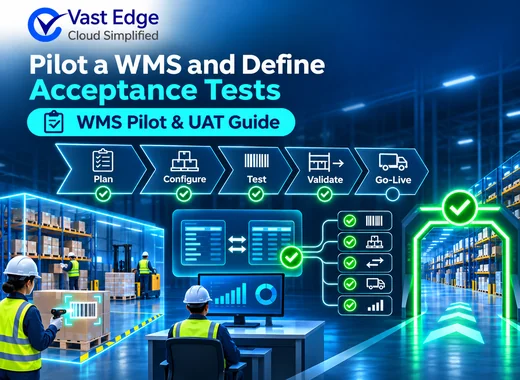
A WMS pilot should prove a limited but representative warehouse flow before broad rollout. Define pass criteria for data, devices, receiving, put-away, replenishment, picking, packing, shipping, returns, counts, integrations, permissions and support. Use real roles and exception cases, reconcile inventory, record evidence and allow go-live only when critical failures have owners and retest results.
How Do You Pilot a WMS and Define Acceptance Tests?
PublishedNov 24, 2026
C
AuthorChloe Gallagher
What should be inside and outside the pilot scope?
What should be inside and outside the pilot scope? Begin with one representative area, products, order types, shifts, interfaces and explicit exclusions without hiding critical dependencies. Define the business event, the authoritative record and the person responsible for the outcome. A feature label is not an acceptance standard. The procedure must explain what is expected, what evidence proves completion and which condition requires escalation.
Create a normal path and an exception path for one representative area, products, order types, shifts, interfaces and explicit exclusions without hiding critical dependencies. Use unique identifiers, timestamps and reason codes so another reviewer can reconstruct the action. Where a decision can change inventory, access or recoverable data, require an approved owner and preserve the before-and-after state.
Test one representative area, products, order types, shifts, interfaces and explicit exclusions without hiding critical dependencies with representative data and least-privilege roles. Include a partial transaction, invalid input, duplicate attempt and delayed dependency. Compare the final business result with operational logs, then classify each gap as data, configuration, process, integration, permission or product scope.
Add one representative area, products, order types, shifts, interfaces and explicit exclusions without hiding critical dependencies to the operating review. Track recurring failures, the oldest unresolved exception and corrective actions. A successful test should be repeatable by the assigned team, not dependent on an undocumented workaround or one administrator’s memory.
| Area | Example acceptance evidence | No-go trigger |
|---|---|---|
| Inventory | Item and location totals reconcile | Unexplained material variance |
| Integration | Failed and duplicate messages recover safely | Orders or shipments can post twice |
| Operations | Users complete normal and exception flows | Critical flow needs undocumented workaround |
Which data and devices must be production-like?
Which data and devices must be production-like? Begin with clean item and location masters, labels, units, lots or serials, handheld devices, printers, network conditions and user roles. Define the business event, the authoritative record and the person responsible for the outcome. A feature label is not an acceptance standard. The procedure must explain what is expected, what evidence proves completion and which condition requires escalation.
Create a normal path and an exception path for clean item and location masters, labels, units, lots or serials, handheld devices, printers, network conditions and user roles. Use unique identifiers, timestamps and reason codes so another reviewer can reconstruct the action. Where a decision can change inventory, access or recoverable data, require an approved owner and preserve the before-and-after state.
Test clean item and location masters, labels, units, lots or serials, handheld devices, printers, network conditions and user roles with representative data and least-privilege roles. Include a partial transaction, invalid input, duplicate attempt and delayed dependency. Compare the final business result with operational logs, then classify each gap as data, configuration, process, integration, permission or product scope.
Add clean item and location masters, labels, units, lots or serials, handheld devices, printers, network conditions and user roles to the operating review. Track recurring failures, the oldest unresolved exception and corrective actions. A successful test should be repeatable by the assigned team, not dependent on an undocumented workaround or one administrator’s memory.
How should workflow acceptance tests be written?
How should workflow acceptance tests be written? Begin with preconditions, steps, expected result, evidence, severity, owner and retest status for ordinary and exception paths. Define the business event, the authoritative record and the person responsible for the outcome. A feature label is not an acceptance standard. The procedure must explain what is expected, what evidence proves completion and which condition requires escalation.
Create a normal path and an exception path for preconditions, steps, expected result, evidence, severity, owner and retest status for ordinary and exception paths. Use unique identifiers, timestamps and reason codes so another reviewer can reconstruct the action. Where a decision can change inventory, access or recoverable data, require an approved owner and preserve the before-and-after state.
Test preconditions, steps, expected result, evidence, severity, owner and retest status for ordinary and exception paths with representative data and least-privilege roles. Include a partial transaction, invalid input, duplicate attempt and delayed dependency. Compare the final business result with operational logs, then classify each gap as data, configuration, process, integration, permission or product scope.
Add preconditions, steps, expected result, evidence, severity, owner and retest status for ordinary and exception paths to the operating review. Track recurring failures, the oldest unresolved exception and corrective actions. A successful test should be repeatable by the assigned team, not dependent on an undocumented workaround or one administrator’s memory.
What integration and reconciliation tests are required?
What integration and reconciliation tests are required? Begin with purchase and sales orders, receipts, shipments, adjustments, failed messages, retries, duplicates, control totals and financial posting. Define the business event, the authoritative record and the person responsible for the outcome. A feature label is not an acceptance standard. The procedure must explain what is expected, what evidence proves completion and which condition requires escalation.
Create a normal path and an exception path for purchase and sales orders, receipts, shipments, adjustments, failed messages, retries, duplicates, control totals and financial posting. Use unique identifiers, timestamps and reason codes so another reviewer can reconstruct the action. Where a decision can change inventory, access or recoverable data, require an approved owner and preserve the before-and-after state.
Test purchase and sales orders, receipts, shipments, adjustments, failed messages, retries, duplicates, control totals and financial posting with representative data and least-privilege roles. Include a partial transaction, invalid input, duplicate attempt and delayed dependency. Compare the final business result with operational logs, then classify each gap as data, configuration, process, integration, permission or product scope.
Add purchase and sales orders, receipts, shipments, adjustments, failed messages, retries, duplicates, control totals and financial posting to the operating review. Track recurring failures, the oldest unresolved exception and corrective actions. A successful test should be repeatable by the assigned team, not dependent on an undocumented workaround or one administrator’s memory.
How should security and operational support be tested?
How should security and operational support be tested? Begin with least-privilege roles, supervisor overrides, audit history, monitoring, incident routing, support hours and fallback procedures. Define the business event, the authoritative record and the person responsible for the outcome. A feature label is not an acceptance standard. The procedure must explain what is expected, what evidence proves completion and which condition requires escalation.
Create a normal path and an exception path for least-privilege roles, supervisor overrides, audit history, monitoring, incident routing, support hours and fallback procedures. Use unique identifiers, timestamps and reason codes so another reviewer can reconstruct the action. Where a decision can change inventory, access or recoverable data, require an approved owner and preserve the before-and-after state.
Test least-privilege roles, supervisor overrides, audit history, monitoring, incident routing, support hours and fallback procedures with representative data and least-privilege roles. Include a partial transaction, invalid input, duplicate attempt and delayed dependency. Compare the final business result with operational logs, then classify each gap as data, configuration, process, integration, permission or product scope.
Add least-privilege roles, supervisor overrides, audit history, monitoring, incident routing, support hours and fallback procedures to the operating review. Track recurring failures, the oldest unresolved exception and corrective actions. A successful test should be repeatable by the assigned team, not dependent on an undocumented workaround or one administrator’s memory.
For related context, review the open-source WMS guide, warehouse management trends guide and ACT Enviro WMS case study. These resources provide context and do not replace the topic-specific acceptance checks above.
What determines a go-live or no-go decision?
What determines a go-live or no-go decision? Begin with critical defect thresholds, inventory variance, interface backlog, user readiness, rollback ability, approvals and unresolved risk. Define the business event, the authoritative record and the person responsible for the outcome. A feature label is not an acceptance standard. The procedure must explain what is expected, what evidence proves completion and which condition requires escalation.
Create a normal path and an exception path for critical defect thresholds, inventory variance, interface backlog, user readiness, rollback ability, approvals and unresolved risk. Use unique identifiers, timestamps and reason codes so another reviewer can reconstruct the action. Where a decision can change inventory, access or recoverable data, require an approved owner and preserve the before-and-after state.
Test critical defect thresholds, inventory variance, interface backlog, user readiness, rollback ability, approvals and unresolved risk with representative data and least-privilege roles. Include a partial transaction, invalid input, duplicate attempt and delayed dependency. Compare the final business result with operational logs, then classify each gap as data, configuration, process, integration, permission or product scope.
Add critical defect thresholds, inventory variance, interface backlog, user readiness, rollback ability, approvals and unresolved risk to the operating review. Track recurring failures, the oldest unresolved exception and corrective actions. A successful test should be repeatable by the assigned team, not dependent on an undocumented workaround or one administrator’s memory.
How should pilot findings become rollout controls?
How should pilot findings become rollout controls? Begin with configuration baseline, training changes, runbook updates, rollout sequence, measurable controls and post-go-live review. Define the business event, the authoritative record and the person responsible for the outcome. A feature label is not an acceptance standard. The procedure must explain what is expected, what evidence proves completion and which condition requires escalation.
Create a normal path and an exception path for configuration baseline, training changes, runbook updates, rollout sequence, measurable controls and post-go-live review. Use unique identifiers, timestamps and reason codes so another reviewer can reconstruct the action. Where a decision can change inventory, access or recoverable data, require an approved owner and preserve the before-and-after state.
Test configuration baseline, training changes, runbook updates, rollout sequence, measurable controls and post-go-live review with representative data and least-privilege roles. Include a partial transaction, invalid input, duplicate attempt and delayed dependency. Compare the final business result with operational logs, then classify each gap as data, configuration, process, integration, permission or product scope.
Add configuration baseline, training changes, runbook updates, rollout sequence, measurable controls and post-go-live review to the operating review. Track recurring failures, the oldest unresolved exception and corrective actions. A successful test should be repeatable by the assigned team, not dependent on an undocumented workaround or one administrator’s memory.
Key Takeaways
- 01Start with a defined business outcome, authoritative record and accountable owner.
- 02Test both normal activity and difficult exceptions with representative data.
- 03Use measurable acceptance evidence and business-owner validation before closing the work.
- 04Record product limits and observed results without converting them into universal guarantees.
Explore the Relevant Vast Edge Solution
If your organization needs support applying these controls, review Vast Edge WMS. Use a discovery session to confirm supported scope, exclusions, administration and acceptance evidence before discussing implementation or service options.
Loading...