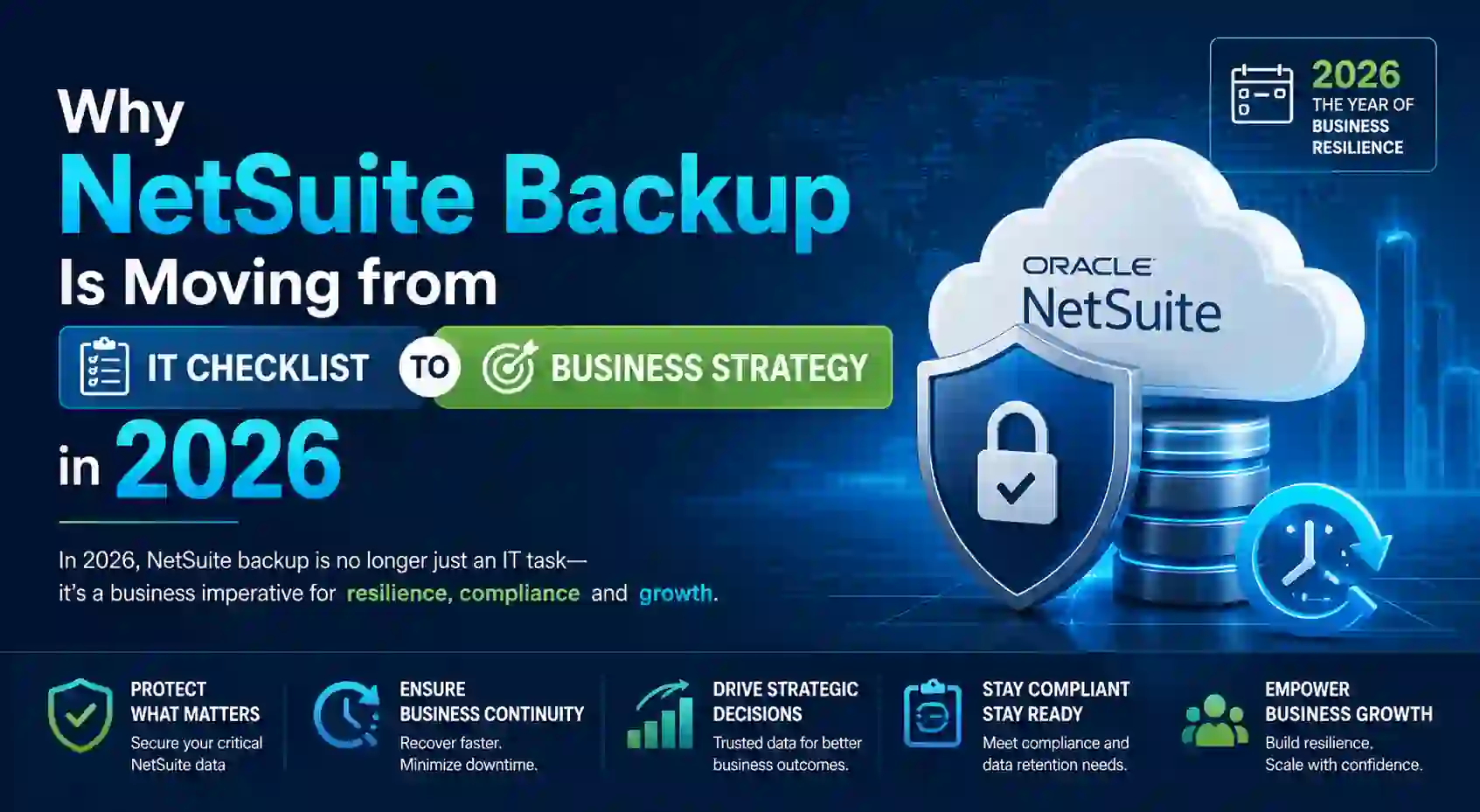
ERP data protection has traditionally been treated as an IT responsibility. Today, that perspective is changing. As Oracle NetSuite becomes the system of record for finance, operations, customer data, and reporting, organizations are paying closer attention to how that information is protected, retained, and recovered.
The conversation around NetSuite backup has expanded beyond IT teams and system administrators. Business leaders, compliance officers, and finance departments increasingly recognize that data recovery readiness plays a direct role in operational continuity, audit preparation, and risk management.
Why NetSuite Backup Is Moving from IT Checklist to Business Strategy in 2026
Last Updated • 8 Oct 2026
C
AuthorChloe Gallagher
That shift is also influencing software procurement. When Vast Edge recently made its NetSuite Backup & Restore Solution available through Microsoft Marketplace, the move reflected a broader market trend. Organizations are actively evaluating ERP data protection solutions through the same procurement channels they use for other enterprise software investments.
The importance of NetSuite backup is no longer a niche discussion among database administrators. It has become part of broader conversations around business continuity, governance, and resilience as organizations increase their reliance on cloud-based ERP systems.
Why Has NetSuite Become Mission-Critical for Modern Businesses?
Understanding why ERP data protection matters requires first understanding how central NetSuite has become to day-to-day operations. The key advantages of NetSuite ERP, including unified financial management, real-time reporting, multi-subsidiary support, built-in CRM functionality, inventory management, and revenue recognition capabilities, have made it a foundational platform for mid-market and enterprise organizations alike.
The role of NetSuite in the SaaS industry is particularly significant. As companies continue moving away from on-premises systems, NetSuite has become a preferred cloud ERP platform for organizations seeking scalability, visibility, and operational efficiency. It centralizes information that once existed across disconnected applications, bringing together finance, customer, operational, and reporting data into a single environment.
This consolidation improves efficiency while increasing dependency on a single source of business data. When critical information is centralized, the impact of a data integrity issue can extend across multiple departments and business processes.
Digital transformation initiatives have accelerated this trend. Organizations increasingly connect NetSuite with CPQ systems, e-commerce platforms, payroll applications, analytics tools, and customer relationship management solutions. As NetSuite becomes more integrated into business operations, recovery planning becomes increasingly important.
Why Is NetSuite Backup Becoming a Business Priority?
The value of a NetSuite backup strategy often becomes most apparent when a recovery event occurs. Many organizations assume their data is protected until they encounter a situation that requires restoring historical information, recovering deleted records, or validating audit trails.
Oracle provides infrastructure availability and reliability for NetSuite. Native tools such as CSV exports, saved searches, and SuiteAnalytics are designed primarily for reporting and data access. They are not intended to provide customer-controlled, point-in-time recovery or granular restoration capabilities.
The practical differences are clearer in this native tools versus dedicated backup comparison.
This distinction has practical implications. A finance team that accidentally overwrites vendor records during a bulk update may need to recover specific fields rather than restore an entire environment. An auditor reviewing compliance documentation may require verifiable historical records with timestamps and change tracking. An administrator troubleshooting a SuiteScript-related issue may need access to previous data states to support remediation efforts.
Operational continuity and audit readiness are two common situations that highlight the importance of NetSuite backup. Organizations operating under regulatory frameworks or managing large volumes of business-critical data often find that a dedicated recovery strategy becomes increasingly necessary as they grow.
Effective Strategies for NetSuite Recovery typically combine regular backup validation, granular restore capabilities, long-term data retention, and documented recovery procedures. Organizations that periodically test their recovery workflows are often better prepared to respond to accidental data changes, integration-related issues, and compliance-related requests without disrupting day-to-day operations.
What Are the Most Common ERP Data Protection Challenges?
ERP data protection presents challenges that differ from traditional file backup or infrastructure recovery. NetSuite environments contain transactional data, relationships between records, customizations, workflows, and integrations that require specialized recovery considerations.
User errors remain one of the most common causes of data issues. Bulk imports, workflow changes, record updates, or incorrect permissions can affect hundreds or thousands of records before discrepancies are discovered.
Integration-related issues can also introduce risk. Modern NetSuite environments frequently exchange information with CRM systems, CPQ platforms, payroll applications, analytics tools, and third-party SaaS services. When integration failures occur, data inconsistencies can spread across systems before they are identified and corrected.
Compliance obligations create additional complexity. Organizations subject to SOX, HIPAA, GDPR, or industry-specific requirements must often demonstrate data integrity, maintain historical records, and provide evidence of governance controls. Meeting these requirements manually can be resource-intensive and difficult to scale.
As ERP ecosystems become more interconnected, data protection strategies must address both operational recovery and regulatory expectations.
What Should Businesses Look for in Cloud Backup and Recovery Solutions?
As ERP data protection requirements evolve, organizations are becoming more selective when evaluating cloud backup and recovery solutions.
Encryption remains a foundational requirement. AES-256 encryption for data at rest and in transit is widely considered a baseline expectation for protecting sensitive business information. Encryption alone does not determine the effectiveness of a backup solution.
Recovery flexibility is equally important. Organizations often require the ability to restore specific fields, records, or historical snapshots rather than performing a complete environment rollback. Granular recovery options can significantly reduce disruption when addressing data integrity issues.
Retention capabilities should also align with business and regulatory requirements. Many organizations need access to historical records for several years, making long-term retention and searchable archives important considerations.
Governance features such as audit trails, access controls, compliance logging, and reporting capabilities provide additional value. These features help transform backup systems into tools that support compliance and oversight initiatives.
Analytics and dashboard visibility can further improve operational efficiency by helping administrators monitor backup status, recovery readiness, and historical trends.
Organizations evaluating cloud backup and recovery solutions against these criteria often achieve stronger long-term outcomes than those treating backup as a basic infrastructure requirement.
Why Free NetSuite Backup for SMBs Is Becoming a Strategic Investment
Smaller organizations sometimes assume that backup and recovery planning is primarily an enterprise concern. In practice, SMBs often face many of the same data recovery challenges as larger organizations.
The availability of free NetSuite backup for SMBs and entry-level subscription options has made dedicated recovery solutions more accessible. This has allowed growing organizations to establish stronger data protection practices earlier in their growth journey.
A professional services company with a relatively small workforce may still store years of financial records, customer billing information, project histories, and operational data within NetSuite. Reconstructing that information after a significant data event could require substantial time and resources.
Compliance expectations are also expanding beyond large enterprises. Customer requirements, cyber insurance assessments, and vendor due diligence processes increasingly evaluate whether organizations maintain documented backup and recovery procedures.
As a result, SMBs are beginning to view recovery planning as a business investment rather than a purely technical expense.
How Integration Complexity Impacts NetSuite Recovery Planning
For organizations operating within broader SaaS ecosystems, recovery planning extends beyond NetSuite itself.
A practical NetSuite integration guide for recovery planning should identify all inbound and outbound data flows connected to the ERP environment. This includes understanding which systems write data into NetSuite, which systems consume NetSuite data, how frequently synchronization occurs, and how dependencies affect business operations.
When a data integrity event occurs, the impact often extends beyond a single application. CRM platforms, CPQ solutions, analytics systems, payroll software, and operational tools may all contain synchronized records that depend on accurate NetSuite data.
This interconnected architecture makes recovery planning more complex. Organizations must consider not only how to restore information within NetSuite, but also how recovery actions affect connected systems.
As integration ecosystems expand, tested recovery procedures become just as important as maintaining reliable backups.
What Does the Microsoft Marketplace Listing Reveal About ERP Data Protection Demand?
Vast Edge's decision to make its NetSuite Backup & Restore Solution available through Microsoft Marketplace reflects broader changes in how organizations evaluate and procure enterprise software.
Organizations increasingly prefer evaluating software through established marketplaces because these channels often align with existing procurement, governance, and vendor management processes. Marketplace-based sourcing can simplify software evaluation while supporting purchasing transparency and compliance objectives.
The Vast Edge solution available through Microsoft Marketplace includes AES-256 encryption, daily incremental backups, monthly full backups, field-level restore capabilities, SuiteScript support, audit log capture, compliance-focused controls, and single sign-on integration with Microsoft 365 and Google Workspace.
Additional capabilities include retention options of up to seven years, dashboard visibility, customizable recovery workflows, and support for organizations operating under frameworks such as SOX, HIPAA, and GDPR.
Buyers can use this Microsoft AppSource evaluation guide to review marketplace information alongside recovery, retention, and governance requirements.
Additional information about the solution is available through the Microsoft Marketplace listing:
The availability of a dedicated NetSuite backup solution through a major enterprise marketplace highlights the growing recognition of ERP data protection as a distinct technology category. Increasingly, organizations evaluate backup and recovery platforms alongside security, analytics, and operational software rather than treating them as isolated IT projects.
Conclusion
ERP data has always been critical to business operations. What has changed is the level of attention organizations are giving to recovery readiness, governance, and long-term data protection.
For organizations relying on NetSuite, the difference between having access to data and having a structured recovery strategy is becoming increasingly important. Compliance requirements, governance expectations, and operational resilience initiatives are all contributing to greater attention on backup and recovery planning.
Recovery readiness is no longer solely an IT concern. It has become part of broader business continuity, risk management, and governance discussions.
The growing availability of dedicated NetSuite backup solutions through mainstream software procurement channels reflects a market that increasingly views ERP data protection as a strategic business requirement rather than a technical afterthought.
Organizations reviewing their current approach should evaluate not only how data is stored and accessed, but also how effectively it can be recovered when business conditions require it.
Loading...
FEATURED BY
Google Cloud
Vast Edge's live recovery interface for cloud backups was highlighted by Google Cloud.
Vast Edge, built on GCP, launches the first live recovery interface for cloud backups, enabling IT teams to inspect, search, preview and validate the exact data available for restore.
Google Cloud
Jul 27 – Jul 31
•
Vast Edge, built on GCP, launches the first live recovery interface for cloud backups, enabling IT teams to inspect backup contents in real time. This transforms backups from a blind, log-based process into an interactive platform where teams can instantly search, preview, and validate the exact data available for restore.
This platform protects Google Workspace, NetSuite, Salesforce, Workday and many SaaS environments, providing complete visibility and enterprise-grade oversight.
Visit Vast Edge Backup & Disaster Recovery and get a free trial of their backup solutions on the GCP Marketplace for Google Workspace Backup, NetSuite Backup, Salesforce Backup, and Workday Backup.
Search
Find your data instantly
Preview
View before you restore
Validate
Ensure the right data
Recover
Restore with confidence